
In-Lab Sleep Testing vs. Home Sleep Testing: What’s the Difference?
If you’ve been experiencing loud snoring, daytime fatigue, morning headaches, restless sleep, or other signs of a sleep disorder, your healthcare provider may recommend a sleep test.
But what does that actually involve?
There are two common approaches to sleep testing: an overnight sleep study in a laboratory and a home sleep test. Both can provide valuable information about your sleep, but they are designed for different situations.
Understanding the difference can help you determine which option may be appropriate for you.
What Is an In-Lab Sleep Study?
An in-lab sleep study, also called polysomnography (PSG), takes place overnight at a sleep clinic or hospital.
During the test, a trained sleep technologist monitors several aspects of your sleep, which may include:
Brain activity
Eye movements
Muscle activity
Heart rate
Breathing
Blood oxygen levels
Body position
Leg movements
Snoring
Because of the number of measurements involved, an in-lab study can provide a very detailed picture of what happens while you sleep.
In some cases, an overnight laboratory study may also be used to monitor or adjust treatment during the same night.
When Is an In-Lab Sleep Study Recommended?
A physician may recommend an in-lab study when more detailed monitoring is needed or when there is concern about a sleep disorder that cannot be adequately assessed with a home test.
For example, an in-lab study may be considered when there is suspicion of:
Complex or central sleep apnea
Certain movement-related sleep disorders
Narcolepsy or other neurological sleep disorders
Significant cardiopulmonary conditions
A sleep disorder that requires more detailed monitoring
Your healthcare provider can determine whether an in-lab study is appropriate based on your symptoms and medical history.
What Is a Home Sleep Test?
A home sleep apnea test (HSAT) allows you to collect sleep-related breathing information in your own home.
Instead of spending a night in a sleep laboratory, you use a portable clinical-grade device while sleeping in your own bed.
Depending on the device and testing protocol, a home sleep test may measure things such as:
Breathing patterns
Blood oxygen levels
Heart rate
Snoring
Body position
Airflow
The information is then reviewed and interpreted by qualified sleep professionals.
For people being evaluated for obstructive sleep apnea, home sleep testing can provide an accessible alternative to an overnight laboratory study when clinically appropriate.
In-Lab vs. Home Sleep Testing
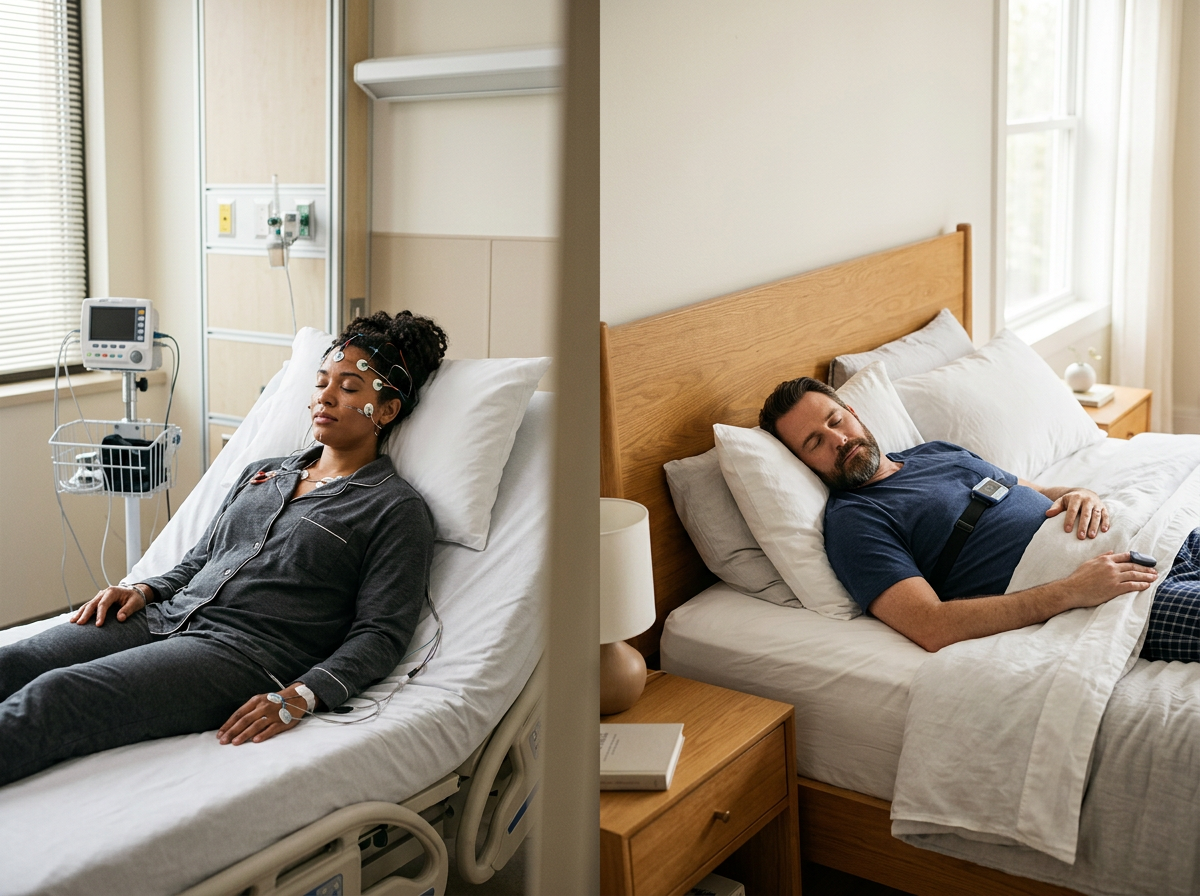
An in-lab sleep study takes place in a sleep clinic or hospital, while a home sleep test is completed in your own home and bed. In-lab testing involves more extensive physiological monitoring and typically requires a technician to be present, while home testing uses a portable device that primarily measures breathing-related information. An in-lab study requires an overnight appointment, whereas home testing can often fit more easily around your schedule. In-lab testing may be recommended for more complex or comprehensive evaluations, while home sleep testing is commonly used for people being evaluated for obstructive sleep apnea. Home testing also allows you to sleep in your familiar environment with portable equipment rather than multiple sensors in a clinical setting.
Is a Home Sleep Test as Accurate as an In-Lab Study?
This is one of the most common questions people ask.
The answer depends on what you are trying to diagnose.
For people with a high likelihood of moderate-to-severe obstructive sleep apnea and without certain complicating medical conditions, home sleep apnea testing is an established diagnostic option.
However, a home sleep test is not a replacement for every type of sleep study.
One important difference is that home sleep testing generally measures fewer signals than a full polysomnography study. It also typically does not directly measure brain waves to determine when you are actually asleep.
That's why the right test depends on the individual.
If a home sleep test is negative, inconclusive, or doesn't adequately explain your symptoms, your healthcare provider may recommend an in-lab sleep study.
Why Choose a Home Sleep Test?
For appropriate patients, one of the biggest advantages of home testing is convenience.
You don't have to spend the night in a sleep laboratory. Instead, you can complete the test in your normal sleep environment.
This can be particularly appealing for people who:
Have difficulty taking time away from work
Live far from a sleep clinic
Prefer sleeping in their own bed
Travel frequently
Want a more convenient way to begin the diagnostic process
And because the test takes place at home, you can follow your normal bedtime routine rather than travelling to a clinic for an overnight appointment.
What Happens After a Home Sleep Test?
Completing the test is only one part of the process.
Once the test is returned, the recorded data should be reviewed and interpreted by an appropriately qualified healthcare professional.
Depending on the results, you may receive recommendations for next steps, which could include treatment, additional testing, or further evaluation.
If the results suggest obstructive sleep apnea, your healthcare provider can discuss treatment options with you.
Which Sleep Test Is Right for You?
There isn't one sleep test that is right for everyone.
In-lab testing provides the most comprehensive monitoring and is important when a more detailed evaluation is required.
Home sleep testing provides a convenient way to evaluate many people who may have obstructive sleep apnea.
The most appropriate option depends on your symptoms, medical history, risk factors, and what your healthcare provider is trying to determine.
If you're experiencing persistent snoring, daytime fatigue, witnessed pauses in breathing, gasping during sleep, morning headaches, or other symptoms of sleep apnea, speaking with a healthcare professional is a good place to start.
Looking for a convenient way to get tested?
Sleep Efficiency provides clinical-grade home sleep testing that allows eligible patients to complete their sleep test from the comfort of home.
Your results are reviewed by qualified sleep professionals, helping you move from testing to understanding your sleep and determining appropriate next steps.
Learn more about home sleep testing with Sleep Efficiency.